Search This Blog

Showing posts with label Science. Show all posts

Wednesday, July 18, 2012

All the Elements of a Good Book

The Disappearing Spoon by Sam Kean

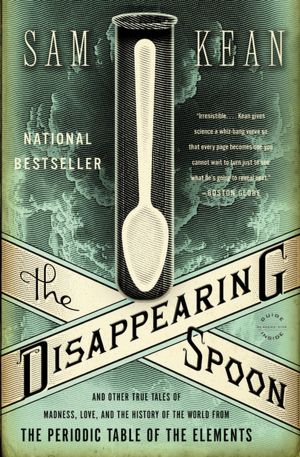
The Disappearing Spoon: And Other True Tales of Madness, Love, and the History of the World from the Periodic Table of the ElementsI am a huge fan of the periodic table!  However lame that may sound, it's true.  The periodic table rocks (and it still would even if it wasn't made up mostly of rocks).  As soon as this book came out, I bought...on my nook and started reading it.  Then life showed up, and it was so much cheaper for me to buy books with my discount, I rarely used my nook and my memory of the book disappeared just like a spoon made of gallium.  Then I saw Sam Kean was coming for an author visit.  I reproached myself for not having read the book yet.  Some fan I was.

But, I did read it.  And, I did love it!  The book is full of stories about each of the elements.  You learn about the periodic table and the elements, but you learn about them from interesting anecdotes and stories.  The side notes are just as enjoyable as the main text.  This is now one of my most favorite books, perhaps even my most favorite non-fiction book.

Not only are the stories engaging, Sam Kean has a scholarly wit in his writing.  At least, that 's the best way I can think to describe it.  An example, though, comes to mind from his newest book, out yesterday, The Violinist's Thumb.  When Kean describes the copying of DNA in the cell, he introduces the image of tiny monks transcribing away within the cell.  It's those types of images and thoughts that takes The Disappearing Spoon from being good to being great.  I'm very excited to read his next book.  And it's not going to be in a year.  Now that I know how well he writes, his next book will be read as fast as my thumbs can turn the pages.

Thursday, April 19, 2012

Deadly Good

The Poisoner's Handbook by Deborah Blum

What a great book!!  I think Bookalicious Babe will agree with me. 

The book is about Charles Norris, New York medical examiner and his toxicologist Alexander Gettler, who worked in the 1920s.  Charles Norris along with Gettler and the help of others started the discipline of forensic science.

I also enjoyed learning about prohibition.  I didn't know anything about it except that it happened.  I love it when you learn something you weren't expecting to while you learn what you were hoping to.

 Blum did an excellent job of organizing the book.  The book follows a timeline while focusing on a specific poison for each chapter.  Blum does a fantastic job of combining the 1920s New York City culture, accurate chemistry, and true crime into one flowing story.  Fans of forensic science, chemsitry, and true crime will love this book.  You've finished Erick Larson and don't know what to read?  Now you do...Deborah Blum.  Co-workers have told me her other book Ghost Hunting, about the search for scientific proof of ghosts, is an excellent book.

Saturday, November 12, 2011

For All Those Math and Science Fans Out There.....Big and Small

A Gebra Named Al by Wendy Isdell

The Mystery of the Periodic Table by Benjamin Wiker


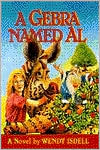
A Gebra Named Al: A NovelSurprisingly, Wendy Isdell wrote her book when she was in eighth grade!  My son and I loved this book.  It's a little bit like Alice in Wonderland except it's Julie in Mathland and the creatures are more helpful.  Julie is transported to a land of math and science (after having a frustrating time doing algebra problems).  On her quest to return home, AL the GEBRA (algebra) and his friends the Periodicals (horses with characteristics of the element they are named after) introduce Julie to the Land of Mathematics.  On the way Julie learns about isotopes, travels through the Order of Operations, and eats fruit shaped like Bohr's model of the atom.  This cute book gives accurate information about science and math concepts.  It's a very pleasurable read.

Mystery Of The Periodic Table     Benjamin Wicker's book is outstanding.  He explains the chemistry behind atoms, elements, and the periodic table so well.  A middle school student could easily read this book independently and understand the concepts and ideas Wicker explains.  Yet, the information is not a dumbed-down presentation, it's powerful concepts illustrated with pictures and words in a way that is easy to understand.  Wicker also keeps the book very interesting throughout by linking the different discoveries together, talking about the personal side of some of these scientist, and asking readers questions directly to make a point and to make them think.  The periodic table is a thing of awesome beauty, and we should all know how it came about and how perfectly the elements in nature fit together.  I cannot recommend this book highly enough.  It seems any book published by Bethlehem Books is a winner (though this book is not religious).

Wednesday, November 2, 2011

Bad Title for a Good Book?

Is God a Mathematician? by Mario Livio

Booker...
Is God a Mathematician?     I enjoyed this book, though it was not the book I thought it would be.  Mario Livio tackles the question whether humans discovered or invented mathematics by tracing the history of mathematics from Pythagerous (ca.597-472 BC) to near present day.  It is an incredible trip with Livio's excellent summarizations, connections, and explanations.  I found it fascinating to learn how certain concepts came about, which mathematicians agreed and disagreed, and how religiously some people took mathematics.  In the last chapter, Livio takes the evidence from the history of mathematics and adds his own opinion on the debate between discovery and invention.  He ends with the indecisive explanation that it is some of both.  Well, I guess if that's how you really feel.  I was looking for something a little more definitive after going through the book, but the history lesson was worth the wishy-washy stance at the end.

Saturday, October 22, 2011

A Brilliant Book

The Creative Brain: The Science of Genius by Nancy Andreasen

The Creative Brain: The Science of GeniusI really enjoyed this book.  It's not that long and worth a second reading to really apply the book to my life and my kids' lives.  At the time of this books publishing Dr. Andreasen, a highly respected and honored doctor, worked as the director of the Mental Health Clinical Research Center at the University of Iowa Carver College of Medicine.  In this book she explores what makes people creative.  She makes this exploration easy to understand and exciting to learn.  This is a fascinating book for anyone interested in the brain, creativity, or a parent or educator.  As a homeschooler, I found many of her discoveries and insights helpful in how I plan my children's education.  Dr. Andreasen examines several creative geniuses.  I remember that most of them had a childhood that was unstructured, allowing them to explore, experiment, play, and observe.  It seems our society is going in the opposite direction in educating our youth.  Dr. Andreasen also touches on the link between genius and mental illness, a topic I would love to read more about.

I feel this book as appeal for most readers, who will find it educational and enjoyable.  I highly recommend this book, and I look forward to reading her other books.

Saturday, April 30, 2011

Left With a Lasting Impression

THE IMMORTAL LIFE OF HENRIETTA LACKS by Rebecca Skloot

Booker...
I don't know how I missed this book when it first came out.  It was even awarded a Discover award from Barnes and Noble, and I missed it.  I'm glad is was promoted again when it came out in paperback.

What an interesting book.  It tells the tale of the cells taken from Henrietta Lacks without her knowledge or permission and how they changed the course of medicine, making possible so many of the medications and advancements we know today.  It also tells the story of the hardship faced my Henrietta Lacks and her children.  As Henrietta's cells multiplied and flourished, her orphaned children faced poverty and abuse.

The Immortal Life of Henrietta Lacks by Rebecca Skloot: Book CoverI was shocked when I realized, the cells discussed in this book started the cell line that I had used when I worked in a lab in college.  And like so many others, I had no idea the history behind them.  I didn't realize they came from cervical cancer cells removed from an African American woman in the 1950s.  I didn't realize that though the lab I worked in paid hundreds, probably thousands of dollars for these cells, while her children couldn't even afford medical insurance. Henrietta's cells led to the creation of medications her children needed, but couldn't get.

The story is not all sad though.  There is courage, determination, and hope.  This book would be an excellent choice for a book group because there are so many things to discuss--the civil rights movement, poverty and access to medical care, the ethics of taking tissue samples and using them for profit, and privacy issues.

I predict this leave quite an impression on you.  It may not leave an immortal impression, but it will last a very long time.

Sunday, April 17, 2011

An Insightful Read

MY STROKE OF INSIGHT: A Brain Scientist's Personal Journey by Jill Bolte Taylor, Ph.D.

I just finished reading this book.  I'd put off reading this book for almost a year.  I wish I hadn't.  I learned a lot from Dr. Taylor's journey.  In the book, Dr. Taylor first introduces herself, her career, and professional activities.  She is a nueroanatomist who also served on the board of NAMI (National Alliance on Mental Illness) with a specific interest in schizophrenia, which her brother suffers from.  On December 10, 1996 this brain scientist has as a serious stroke in the left hemisphere of her brain.

Dr. Taylor first takes us on a tour of the brain and it's workings before telling us the story of her stroke.  This information aids in the appreciation of the rest of her story.  I think part of the reason I put off reading this book was because I felt I already know about the brain because I'm fascinated by it and I didn't want to go through a prolonged lesson of brain anatomy.  However, this is not what Dr. Taylor gives us.  She gives us an interesting overview to help our understanding of what was going on in her brain/mind during her stroke and subsequent recovery. 

The details of what her brain was going through and what she could and could not do during her stroke was very interesting, as was the story of her recovery.  She talks about what she really needed immediately after her stroke and during her recovery.  She gives suggestion on how to treat and help stroke victims based on what she as experiencing.  This was very enlightening and I hope the medical community studies her story and insights.

The most powerful reason for Dr. Taylor to write this book was to show people how they could access the joy and peace residing in the circuitry of our brain's right-hemisphere.  Her stroke basically incapacitated her left-hemisphere for some time, so she was left with a deep feeling of peace and oneness with the universe while she resided nearly wholly in her right-hemisphere.  She gives us practical advice to help us limit the stories our left-hemisphere tells us that cause us to worry and relive emotional baggage and instead to tap into the peace of our right-hemisphere.

Even before I finished this book, I started to use some of her advice and found it really did help me.  I have depression and I get caught in my left-hemisphere loops of chastising and hopelessness so many times each day.  Sometimes I would recognize a negative thought loop, but I didn't know what to do about it.  I felt like there was nothing I could do.  Dr. Taylor guides us in many ways to end this left-sided brain chatter. 

Maybe sometimes this book was a little repetitive, but I found this book extremely interesting as an exploration of the purpose and power of our brains and inspirational as a guide to a more peaceful personal experience. 

I would be remiss not to mention two of Dr. Taylor's messages she works passionately to get out to the public.  They are the importance of helping individuals and their families who have a mental illness and the request that people donate their brains to Harvard's Brain Bank.  Advancement in treating those with mental illness can come more rapidly if scientists have brains to study.  For more information call 1-800-BrainBank.

I personally hope, the more information scientists call learn about the brain can also help those who have autism.  I found it extremely interesting when Dr. Taylor talked about what strengths or weakness she had with the different hemispheres of her brain.  I once saw a theory that an autistic brain was just an extreme "male" brain.  I think it would be an interesting line of investigation to look at the dominance/balance in autistic brains of the left and right hemispheres.  It's seems many people on the autism spectrum excel at activities associated with the left-hemisphere and lack abilities normally associated with the right-hemisphere.  I wonder if there is an imbalance of development or ability in the two hemispheres or problems with the corpus collasum  (the connection between the two hemispheres).

This is not a long book, so it will be well worth your time to read this remarkable story.  (BTW, you can get the hardcover of this book in Barnes and Noble stores for less than $6.00 right now.)
Monday, April 11, 2011

God Created Science and Saw that it was Good

THE LANGUAGE OF GOD: A SCIENTIST PRESENTS EVIDENCE FOR BELIEF by Francis S. Collins

Booker...
I've wanted to read this book for years.  I don't know why it took me so long to get around to it, but I finally did and I really enjoyed it.  Dr. Francis Collins was the lead person for the Human Genome Project.  Dr. Collins (whose profession as a scientist depends on observation, data collection, and analysis) takes you through his journey to belief.  Dr. Collins didn't grow up a "cradle-Christian" and has had painful things happen to his family.  I think that can help the skeptic to be even more open-minded to what Dr. Collins has to say.

The Language of God by Francis S. Collins: NOOKbook CoverHe definitely shows how science and religion on in harmony with each other.  As a serious Catholic and would-be scientist, I have felt this my whole life, but the loudest voices in the discussion are the two extremes: no God or no Science.  My opinion has always been that religion tells us who and science tells us how.  And I have no fear because I know as Pope Leo XIII said, "truth cannot contradict truth".

But that's not the only point Dr. Collins makes.  He makes a logical basis for believing in God.  Some of the points he discusses include the overall moral scales that humans across the globe have and our emotional responses to beauty.  A symphony is actually only sound waves vibrating in the air to our ear, yet it can stir powerful emotions within us. 

I highly recommend this book for people who don't think science and religion work together, those who think believing in God is illogical or a crutch, for those who want to know how to talk with others about their doubts, and for those who appreciate the beauty in the science of creation.

At the end of the book, Dr. Collins offers a synopsis of a few bioethics situation.  It's not an in depth discussion--it's not meant to be, but it's good for sparking discussion or pondering for those who haven't though about it before.  The book also includes further resources and a reading group discussion guide.

Monday, March 28, 2011

A Sleeper You Might Have Missed

THE FAMILY THAT COULDN'T SLEEP:  A MEDICAL MYSTERY  by D. T. Max

Booker...
The Family That Couldn't Sleep is both a history of our knowledge of prions and the story of an Italian family struggling with a fatal disease passed through generations adeptly interwoven by D. T. Max.  The book opens at a gathering of family members in Italy.  The family is plagued by an extremely rare disease that manifests in a person's thirties and slowly kills them as they lose the ability to sleep.  Some believe this disease may be caused by a prion or something related to a prion.  A prion is a small chain of amino acids, basically a renegade protein that can wreak havoc in the brain.  D. T. Max does an excellent job of keeping the science understandable and interesting.  As we learn more about the family's history we also learn of the history of prions, including what they are, where they might have come from, how prions manifest disease in animals and humans, how prion diseases have spread, all way to our current age of dealing with mad cow disease and brain disease Creuzfeldt-Jakob Disease.  The stories of the Nobel Prize winning scientist are just as fascinating and startling as the rest of the book.  As the story unfolds we travel from the streets of Italy to the jungles of  New Guinea.  D. T. Max, who suffers from a neurological disorder, does a wonderful job of weaving the science and human condition together with sympathy and talent.